Research Grants: Where to Find Them?

Early in my second year of grad school, the professor teaching my research seminar course assigned us a report on available grants in our field of study. I can no longer recall if there was a minimum number we had to identify, or what the report required as far as a description of these grants, but it was an incredibly useful exercise for learning where to find funding opportunities. Here are some of my tried-and-true sources for finding calls for proposals (CFPs):

1. AHA Today: The blog of the American Historical Association, for me, has replaced the old method of reading the back pages of Perspectives (the AHA's print publication). This blog does not exclusively publish information on research grants but when an exciting funding opportunity arises the AHA usually publicizes it in a short blog post. 

2. H-Net: The best way to describe H-Net is a giant group email (listserv) for humanists and social scientists who study a particular topic. For example, I subscribe to H-Urban and H-Jewish Studies. As a subscriber, I receive occasional email updates about conferences, publications, and grants. There are SO MANY different H-Networks, and thus many different ways to find out about opportunities. 

3. Professional Affiliations: In addition to the AHA, there are many smaller professional organizations dedicated to particular historical subjects. As a member of the Association for Jewish Studies I get access to a Grants Directory that lists all of the CFPs related to Jewish history (note: the directory also includes grants for research in other disciplines). Joining a professional organization usually offers the benefit of accessing aggregated or pre-circulated grants in that field of study. 

4. Google: With the appropriate search terms, it's possible to find grants you may have otherwise missed. Even after a thorough scouring of the sources listed above, it's valuable to do a general search like "civil war history grants" or "funding for oral history projects." It might turn out to be a duplication of effort or redundant, but who knows--it could turn up a more obscure pot of money. 

5. Word of mouth: My advisor has passed on a lot of grants to me over the years, because after 20+ years of scholarship and professing she is on way more email lists than I am. I've also had colleagues pass along opportunities that they thought were a good fit with my research interests. Sometimes those end up being too much of a stretch, but I've applied for several grants that I found that way! It's important to build a strong network, because there aren't enough hours in the day to do research and find all of the various possibilities for how you can fund it. Colleagues help each other out by sharing information. 

Any other good suggestions for where to find research money?
Grants: Why do historians apply for them?

At this time of year, graduate students (and faculty, too) scramble to apply for research grants. Grant deadlines fall throughout the year, but often the year-long fellowships that begin in August/September post their call for proposals (CFPs) in October or November, set their deadline for January or February, and notify accepted recipients between March and May. I personally will submit three grants within a three week span in February. 

If research is a requirement of our jobs, why do we apply for money to do our jobs? That's a good question, and one that requires a long discussion of the university's relationship to capitalism. Leaving that aside, however, there are three big reasons why graduate students, postdocs, and faculty members (from junior profs to the most senior scholars) all compete for a small number of opportunities:

1. Research is expensive! In the discipline of history, we often need to travel to archives to read our documents. Digitization has greatly reduced the cost of research--you don't have to travel when a collection has been made available online--but digitization has also put pressure on researchers to look at more and more sources. To write a book (or heck, even a good journal article) requires multiple archival visits. Sometimes these archives are in the same city, which is convenient and efficient, and sometimes a project demands that a scholar make costly visits to archives all over the country. The travel itself is expensive, but with housing and food and other incidentals it really adds up. Sometimes you end up with big photocopy bills, too (oops). Grants can reduce or cover the costs of visiting archives. 

One other thing that grant money can buy is time. If you're usually paid to teach, a grant can buy you out of that responsibility and give you more time to write or travel. What happens is that the grant pays your salary, and your university then uses the money it usually spends on you to hire a replacement instructor. When scholars are in the writing phase of a project, this grant of protected time is especially valuable. 

2. Grants are prestigious! A grant application is a description of the research project that the funds would subsidize. Receiving a grant is thus an endorsement of your research. It's an institution's way of saying, "hey! we think you're doing interesting work! we want you to keep doin' what you're doin'!" You get to write it on your CV and when your university or other scholars see it they think you are very smart and accomplished.

3. Money begets more money. Funding institutions do not like to take risks. If they see that other, similar funders have endorsed your research, you look like a safe bet. The buckshot approach is thus the best method for applying for grants. Researchers send out as many applications as possible and hope that they'll be chosen eventually. Once you've gotten a few, though, the odds improve.

This week, I will talk about the tangibles and intangibles of the grant process: how to find and apply for grants, and how to cope with the angst and waiting they inspire. 

Three Books I Recommend About: The History of Social Work

These books were written for an academic audience, but if you can cut through the theory there are many interesting stories about how professional social workers have cared for poor, unwell, and "maladjusted" Americans over the course of the twentieth century. There are many other excellent books on this topic, but these are the three that I find myself consulting most often for my own research.

1. Roy Lubove, The Professional Altruist: The Emergence of Social Work as a Career 1880-1930 (1965)

In this pioneering book, Lubove analyzed the transition of social welfare from charitable voluntarism to expert occupation by identifying how social workers adopted the three main tenets of a professional identity: specialization, bureaucratization, and the formation of an “occupational subculture.” It's a classic--every scholarly history of social work written since the '60s builds on Lubove's theory of how the profession originated.

2. Regina G. Kunzel, Fallen Women, Problem Girls: Unmarried Mothers and the Professionalization of Social Work, 1890-1945 (1993)

While Lubove examined social work professionalization through a political-economic lens, in her 1993 book Regina Kunzel argued that the transition from evangelical “ladies bountiful” to scientific and objective professionals was not smooth or linear but rather a prolonged contestation of expertise and legitimacy. She also gendered Lubove’s professionalization thesis, challenging his implied conception of professionalism as inherently masculine and, conversely, femininity and women’s work as inherently not professional. Fallen Women, Problem Girls emphasized “not only that women participated in the process but that the transition itself was shaped and structured by gender.”  The tense takeover of Florence Crittenden and Salvation Army maternity homes, formerly the purview of evangelical Christian women, provided Kunzel with an excellent case study of how trained social workers sought to “improve the efficiency” of these homes as a mechanism for actually improving their own social status as scientific professionals. By identifying an occurrence of competition among females for professional authority, Kunzel revised a narrative that formerly posited that men seized legitimacy as experts and marginalized women to charitable work.

3.  Daniel Walkowitz, Working with Class: Social Workers and the Politics of Middle-Class Identity (1999)

Published a few years later, in 1999, Daniel Walkowitz’s history of social work accepted Kunzel’s argument that professionalization was gendered but expanded her thesis to examine social workers as laborers embodying a contradictory class status—professionals without autonomy. Working With Class demonstrated that one “symbolic strateg[y]” used by social workers was to call themselves professionals—yet, as an overwhelmingly female workforce, their dependence on their male supervisors and on their wages limited their autonomy and stained their collars blue. Walkowitz argued that this contradiction, plus the rise of consumerism, began divorcing class identity from work over the course of the twentieth century and increasingly rooted it in the home. Working With Class thus attempted to fill a void perceived by Walkowitz, that historians had under-theorized class in studies of twentieth-century work. Accordingly, Walkowitz emphasized that the most interesting feature of labor over the past one-hundred years has been the struggle of “blue collar” workers to enter the middle class while recognizing that professional, “white collar” work was increasingly routinized and dependent. To demonstrate and ground these arguments, Walkowitz contrasted the public New York City Department of Welfare with an exploration of several private agencies funded by the Federation of Jewish Philanthropies of New York, including the Jewish Board of Guardians, Jewish Child Care Association, and Jewish Family Services. This focus on Jewish social workers highlighted the subjectivity and intersectionality of identity and showed how race, gender, and religious commitment were fundamental to the construction of these professionals’ class identity. 

Honorable mention: This book is not a history of social work, but it does include a chapter that address social work professionalization! Elizabeth Lunbeck's The Psychiatric Persuasion (1994) detailed how psychiatrists professionalized and developed their own medical subspecialty. In her second chapter, Lunbeck discussed how psychiatrists’ and social workers’ knowledge and power problematically overlapped—they shared expertise and thus could share professional authority. Psychiatrists created a hierarchy based on gender, wherein men were authoritative medical professionals and women were, well, neither authoritative nor medical professionals. To counter the psychiatrists’ challenge, social workers attempted to become more scientific, adopting educational and licensing standards. In the 1920s, they also began doing psychotherapy casework. Unfortunately, however, women were “doubly handicapped” from gaining the “professional’s distinctive occupational authority” by both their gender and their perceived lack of scientific methods or objectivity.

Are there any other great books on this topic that you recommend? 

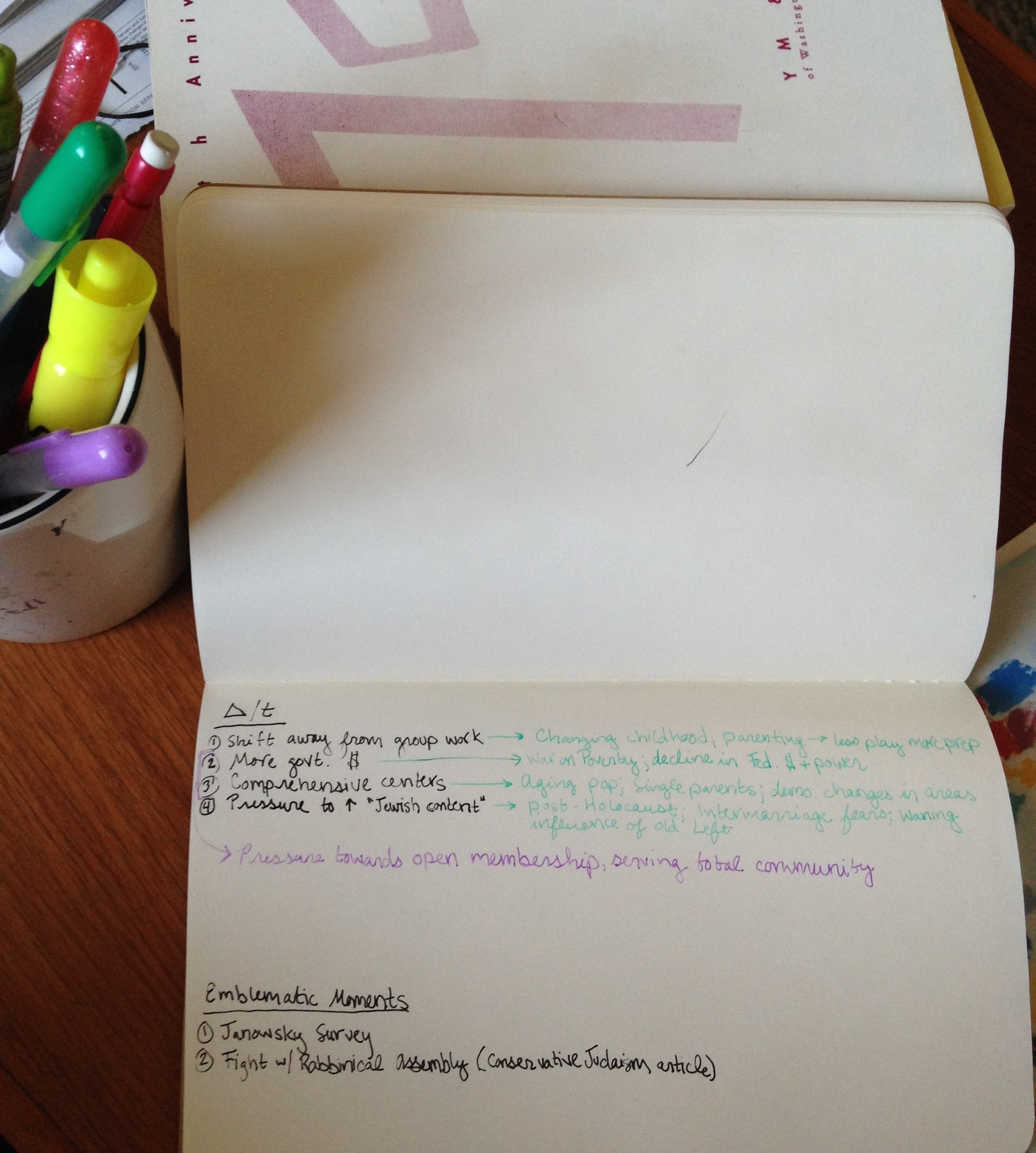
... and comment upon it, I will.

There is little evidence that the center field has tired of its search for the "Jewish content which makes legitimate a Jewish center." The pursuit of this content within the imposing framework of the center field may be leading to distinguishing practices particularly suited to the American Jewish experience.

These last words are admittedly speculative with little in the study to support them. But no observer of Jewish life can rest his case on the purely factual and scientific. There is a mystique beyond correlations and inferences which has always resulted in a "saving remnant" of Jews. Whether this mystique can preserve Jewish identity in the face of the freedom to assimilate and the attractions of acceptance into the broader community in America will remain for the historian to comment upon.

Melvin B. Mogulof, Ph.D., "Toward the Measurement of Jewish Content in Jewish Community Center Practice," (1964).

It's eerie to hear the past speak directly to you.